Catalog Management
The catalog management process includes building a structure of Marketing Catalogs, adding products, and defining catalogs availability. Catalogs are used by managers and sales representatives to create orders.
The Catalog page is implemented as a Lightning component with three tabs:
-
The Details tab with the main catalog info.
-
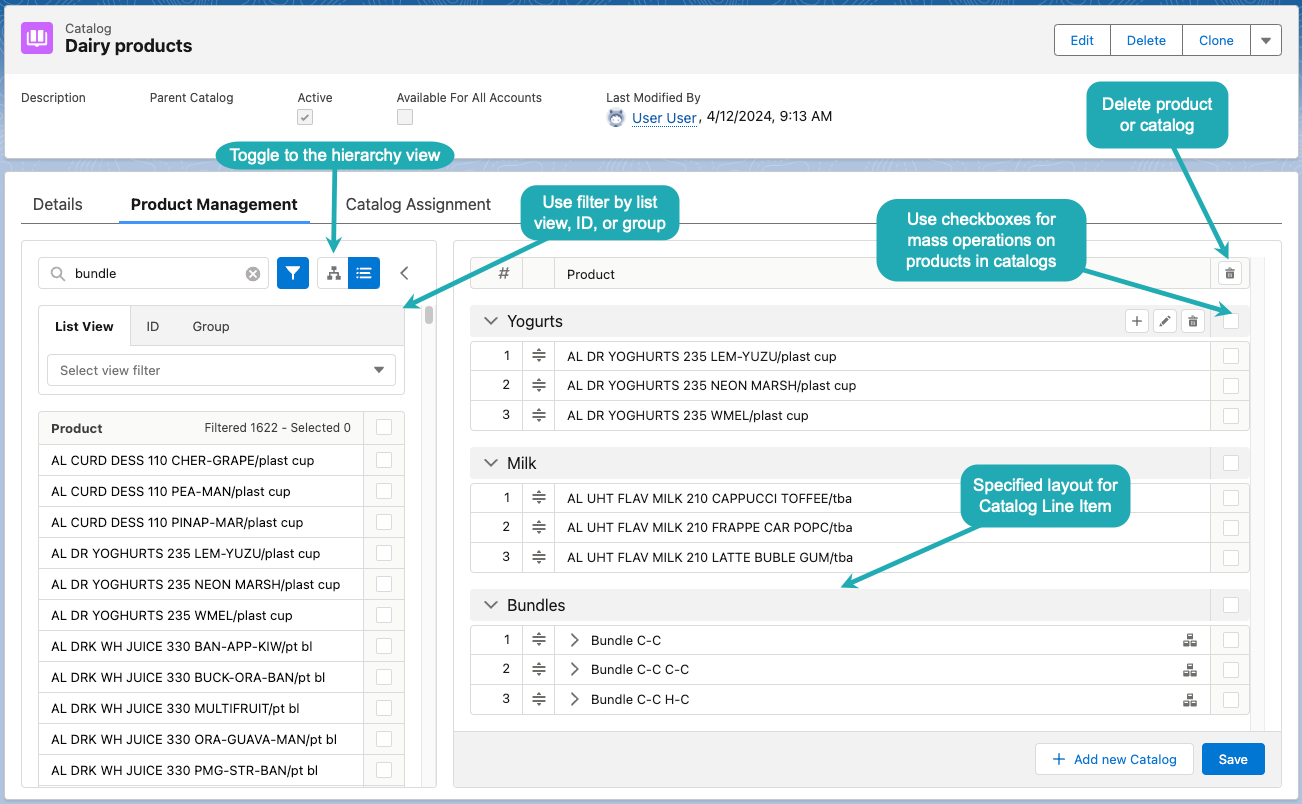
The Product Management tab consists of two sections. The left list section displays a list or hierarchy view of products available for adding to a catalog. The right list section displays products added to a catalog, which are represented as the Catalog Line Item records.
-
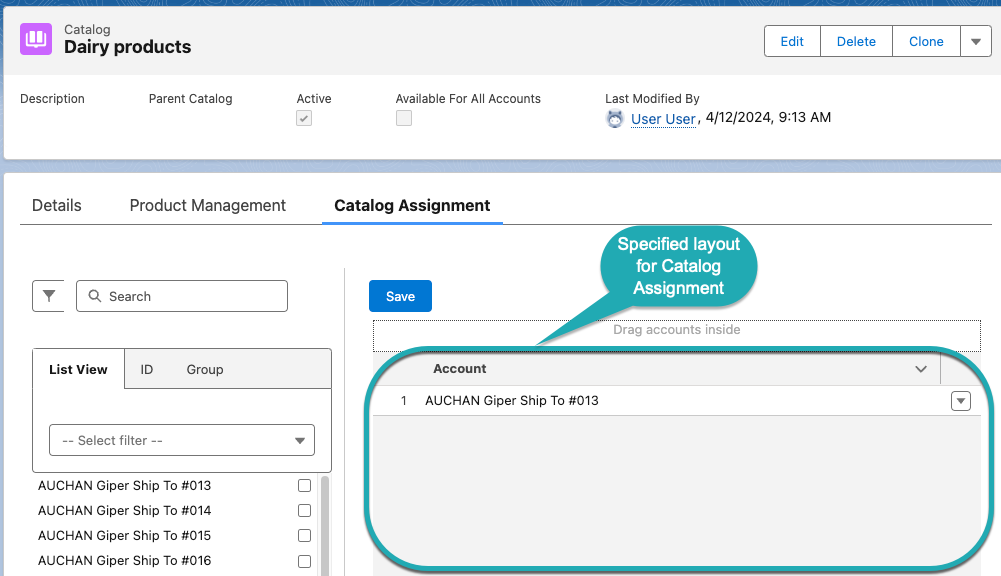
Catalog Assignment tab consists of two sections. The left list section displays a list of catalogs. In the right list section, assign catalogs for accounts.
Product Management
The Product Management tab on the Catalog record page allows you to create a hierarchy with sub-catalogs that include products and product bundles.
-
On the left side, the available catalogs and sub-catalogs are displayed as a list or according to hierarchy. Use the toggle to the appropriate view and the Filter button to sort and search.
-
On the right side, create a hierarchy with sub-catalogs and add products by dragging and dropping them from the left side.
For the Lightning component to work properly with the drag‑and‑drop functionality, make sure that Lightning Web Security is enabled in your org’s Session Settings.
Filtering Options
Search is carried out in the fields that are listed on the product Search Results search layout (including the Name field).
-
Search in list views of general products.
-
Search in dynamic groups.
-
Search by External IDs.
-
Search by a product name.
If you selected multiple filters, the products will be displayed that match all the selected criteria.
Create the SKU checkbox for the target Product object and specify it in the Object Setting record for the SF Instance. This property signifies that this product is a stock-keeping unit that can be added to catalogs.
Create a Hierarchy with Subcatalogs
To add products to catalogs, it is necessary to create a Layout Setting record for the Catalog Line Item object.
| If a Layout Setting for the object is not found or no field is specified, the record ID will be displayed instead of a product name. |
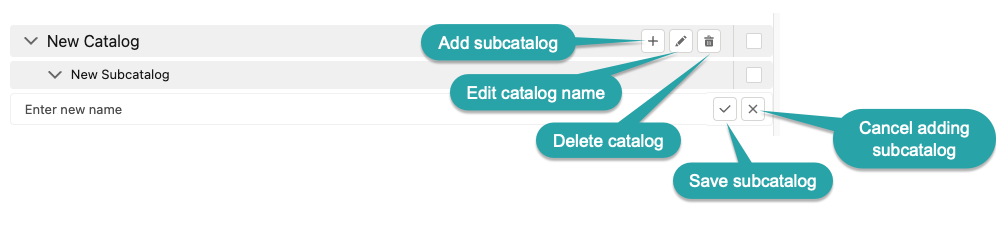
Click Add new Catalog to create a catalog and add sub-catalogs:
-
When you add a sub-catalog, a lookup to the parent catalog is created for the sub-catalog record. The maximum levels in the catalog hierarchy are 4: 1 main + 3 nested sub-catalogs.
-
Products can be added only to the lowest level of a catalog, i.e., if a sub-catalog is created, you can add a product only to this sub-catalog. You can add a product to multiple sub-catalogs. If a catalog has at least one sub-catalog, no products can be added to a parent catalog directly; each product must be assigned to a sub-catalog.
-
Added product is represented as the Catalog Line Item record.
Catalog Assignment
A created catalog can be available for a specific set of accounts or to all accounts in your instance by applying the Available for all accounts checkbox on the Details tab of the Catalog record page. In the latter case, the Sales Org selection field on the catalog settings will be inactive. Otherwise, you need to assign a catalog to accounts, which means creating a Catalog Assignment record.
To display the Catalog Assignment tab on the layout, you need to configure a Layout Setting record for the Catalog Assignment object. Drag and drop catalogs to assign them to the selected Account record.
If you selected multiple filters, accounts will be displayed that match all the selected criteria.
Dynamic Catalog Assignment
The CT solutions support a new feature that allows filtering catalogs available for a selected account dynamically. To apply dynamic search logic:
-
Define the Group and Group Member objects of the CT package you work with (CT CPG, CT Pharma) in the Object Settings.
-
Create a lookup to the Group object of the CT package on the Catalog object.
-
Make sure the catalog is NOT available for all accounts (checkbox is not selected).
-
Create a dynamic group.
-
Assign a dynamic group, create a new Settings record with the Object Setting record type, and specify the referenced objects in Group Object and Group Member Object fields.
Process Path
The following steps must be performed by the administrator to configure the catalogs for further usage:
-
Create the Object Setting record for the SF Instance.
-
Add lookups to a CT Product object.
-
Configure Layout Settings for Catalog Line Item and Catalog Assignment objects.
-
Assign catalogs if required.
See also: